Skip to content
MTGCombos
MenuClose

Share your combos and save your decks.

Join for freeLog in
Magic The Gathering Combos

Home     Submit A Combo     Deck Builder     Forums     Picture Guess     Help

You are not logged in [click to login] - [Join For Free!]  


Gain control of target game (EDH friendly!)

Hover a card name for a preview. Tap or click an image to zoom, or open its rules below.

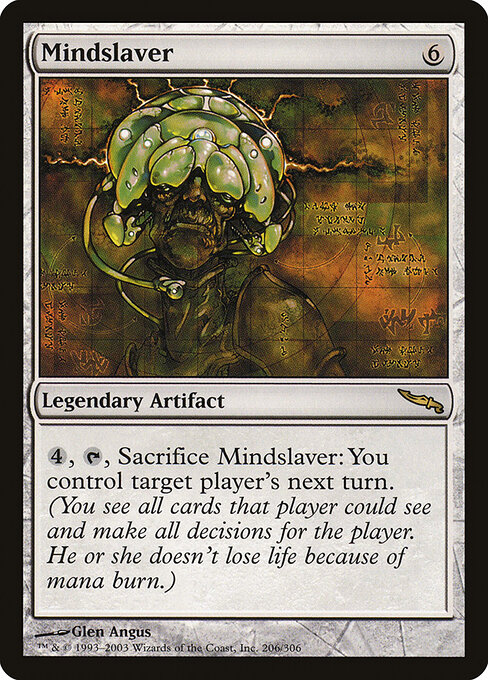
MindslaverEnlarge

Mindslaver

{6}

Legendary Artifact

Mirrodin

Read rules for Mindslaver
{4}, {T}, Sacrifice Mindslaver: You control target player during that player's next turn. (You see all cards that player could see and make all decisions for them.)

Full card details & printings ›

Date Posted: Sat May/22/10 at 10:32 pm

Voal
Posts: 5
Joined: 20-May-10

You need 13 mana, but in EDH that's not so hard, especially since 11 of that mana is colorless.
Date Posted: Sun May/23/10 at 4:25am

ParadoxRemix
Posts: 389
Joined: 22-Feb-10

What's EDH?
Date Posted: Sun May/23/10 at 6:06am

shakii23
Posts: 5711
Joined: 08-Sep-09

EDH is Elder Dragon Highlander...
Elder Dragon Highlander is a Magic: The Gathering variant which provides
a way of encouraging casual, interactive games with a low barrier to
entry while still requiring good deck
building skills. It can be played 1-on-1 but is usually multiplayer.

This page details the official rules common to most groups. Local groups
often play with house rules (check the forum for inspiration), but this
consensus version exists so that players know what to expect if
they join an edh game outside their local play area. In particular,
after-hours EDH games at Pro Tours and Grand Prix use
these rules.


  1. Players must
    choose a legendary creature as the "General" for their deck.
    Details

    Players may choose any legendary creature as their general,
    although some choices may be met with disapproval by other players. Two
    players in the same game may choose the same General, and other players
    may include that card in their Deck even if it's not their General.
    Generals are subject to the Legend rule just like any other
    legendary creature; multiple copies of the same creature (whether
    General and non-General) will all be put into the graveyard (or command
    zone) as a state based effect.

    The General is the principle around which an EDH deck is
    built. It is more easily available than other cards in the deck, and EDH
    decks will ususally want to leverage their General's strengths in their
    plans. It is not, however, guarenteed to be available at every point in
    the game so EDH decks should be able to function without it for a time.


    As of 2009-09-10, this rule has changed. This
    rule supercedes the older (open play or league) rules for Generals in
    EDH games. Note that it is not identical to the Open play Rule.


  2. The General's mana cost defines what colour of mana
    symbols may
    appear on cards in the deck.
    Details

    • Coloured mana symbols which may appear in an EDH deck
      are restricted to the colours appearing in the General's mana cost.
    • Lands whose type includes
      swamp, island, plains, forest and/or mountain (e.g.: basic lands,
      shocklands, dual lands, Shadowmoor special-basics, etc) DO contain the
      corresponding mana symbol(s) as per CR 305.6. As such, they may not
      appear in a deck unless the General is of the corresponding colour(s).
    • While Hybrid mana symbols may be played with
      either colour mana, they
      count as both colours. As such, they may only be played
      with a general
      which is ALL of the hybrid mana symbols' colours.
    • Basic land words (swamp, forest,
      etc) in the text box of a card
      do NOT represent a coloured mana symbol. They are not
      restricted to generals of the same colour.
    An
    Example
    of what cards are/aren't allowed in a three colour deck.


    A deck with Phelddagrif
    (Casting cost 1UWG) as the General may not contain any red
    or black mana symbols.


  3. A deck may not generate mana outside its
    colours. If an effect would generate mana of an illegal colour, it
    generates colourless mana instead.

  4. An EDH deck must contain exactly 100 cards, including
    the General.


  5. With the exception of basic lands, no two
    cards in the deck may
    have the same english name.

  6. EDH is played with vintage legal cards, with two
    exceptions:
    • cards are legal as of their set's prerelease
    • Shahrazad
      is legal for play in EDH


Play rules


  1. The start of game procedure for EDH is as follows:
    1. Players announce their choice of General and move that card
      to the command zone.
    2. Players may then sideboard if the optional
      rules for sideboards
      are being used.
    3. Each player draws a hand of seven cards.
    4. Players may mulligan, using the modified "Partial
      Paris" method
      .

      Partial Paris Mulligan rule

      Because EDH games are long and usually not played in
      multigame matches, EDH uses a modified mulligan rule designed to
      aleviate mana-light hands without significantly increasing the odds of
      finding individual cards. This is also known as the "Brittany" mulligan
      rule.

      1. In turn order, players may exile (face down) some or all
        of the cards in their hand.
      2. Each player then draws one less card from their
        deck than the number they exiled.
      3. Players who exiled at least one card may return to
        step 1 and repeat the process, drawing one less card each time.
      4. Players shuffle all exiled cards into their deck.
      It is worth noting that even with this form of mulligan,
      decks playing an insufficient number of mana sources will routinely draw
      poor hands or insufficient mana as the game progresses.


  2. Being a General is not a characteristic[MTG CR109.3],
    it is a property of the card. As such, "Generalness" cannot be copied or
    overwritten by continuous effects, and does not change with control of
    the card. Examples


    Examples: A Body Double copying a General in a graveyard
    is not a General. A General which is affected by Cytoshape, or is face
    down, is still a General.


  3. If a player has been dealt 21 points of combat damage
    by a particular General during the game, that player loses a game.
    Details

    • This is an additional state based effect.
    • General Damage is cummulative throughout the game; nothing
      can reduce the amount of damage a General has previously done to a
      player.
    • Because it is a property of the card and not a characteristic
      of the game object, a card is still the same General even if it leaves
      the field and returns.
    • While effects can raise a player's life total, it doesn't
      reduce the amount of damage previously taken from a General. (eg: Beacon
      of Immortality)
    • Conversely, combat damage can be reduced, prevented, or
      replaced as it is taken, in which case it was never dealt and
      doesn't count towards the total taken from that General. (eg: Fog or
      Captain's Maneuver)
    • General Damage is specific to each General/Player pairing,
      not combined across all Generals.
    • A player can lose if he or she is dealt 21 points of
      combat damage by his or her own General (ie: under someone else's
      control).

  4. While a General is in the command zone, it may be cast.
    As an additional cost to cast a General from the command zone, its
    owner must pay {2} for each time it was previously cast from the command
    zone. (ie: it costs 6WW to cast for the third time.) Details

    • A General is still subject to the normal timing restrictions
      for casting creatures (unless it has Flash or some other affect allows
      it to be played at another time, such as Vedalken Orrery)

  5. If a General would be put into a graveyard or exile from
    anywhere, its owner may choose to move it to the command zone instead.
    Details

    • This is a replacement effect; the creature never goes to the
      graveyard and will not trigger such abilities.
    • Generals will move to the library or hand as normal; only
      transitions to Exile or the Graveyard may be replaced.

  6. Players begin the game with 40 life.


  7. Generals are subject to the Legend rule; they
    will be put into the graveyard or command zone at the same time as any
    other Legendary creatures with the same name.


  8. New: Abilities which
    refer to other cards owned outside the game (Wishes, Spawnsire,
    Research, Ring of Ma'ruf) do not function in EDH unless the optional
    sideboard rule is in use. If sideboards are used, wishes and similar
    cards may retrieve sideboard cards.
EDH is designed to promote social interaction.

It is founded (and dependant) on a social contract,
otherwise
known as a gentleman's agreement. Unsporting conduct (whether
extreme
or simply "being a jerk") should not be tolerated by players.
Refusing
to play with antisocial persons is the fastest way to better EDH
community.


However, because players have varied opinions of what
constitutes fair and/or fun play, a recommended banned list is
maintained to help guide players towards a good social
experience.
House rules or "fair play" exceptions are always encouraged
if they result in more fun for the local community.


If you want to enjoy the type of games you've heard
associated
with EDH, avoid cards like these:


Additionally
the following legends should not be used as a General:

Braids,
Cabal Minion (Effective 2009-06-20)\


EDH is designed first and foremost for social players. It cannot
be all things to all people.


Nevertheless, many people like to play EDH for prizes or
other non-social incentives. Those incentives can help build
communities and playgroups, but they can also undermine the
social
contract which keeps EDH balanced.


When running a competitive EDH event, the recommended list of
cards
to avoid (under the primary, "social" rules) is one place to
start.
It is not however, nor is it intended to be, comprehensive. It
still
allows for a very high level of power, in part because there are
many,
many two card instant wins in the history of Magic. Additional
structure is required to keep degeneracy
1
in check. To that
end, a selection of optional rules are provided here for
prospective TOs or players who find their playgroup can't find a
balance.

Degenerate: adj
Having fallen below a normal or desireable state, especially
functionally, morally, or socially. Having atrophied or declined to a
state of sameness.

Since one of the primary features of EDH is the variety
of games, and the variable nature of the problem each game presents,
degenerate plays are those which take away from the variety and
unpredictable nature of EDH games


Optional rules for EDH

  1. EDH
    Sideboards


    Rather than filling every deck with banal responses, it is
    preferable to allow some flexibility in the composition
    of a deck.


    • Players may bring a 10 card sideboard in addition to their
      99 cards and 1 General.
    • After generals are announced, players have 3
      minutes to make 1-for-1 substitutions to their deck.
    • Any cards not played as part of the deck may be
      retrieved by "wishes".
    Reasoning:

    Highly tuned threats piloted by skilled opponents mandate
    efficient answers. The minimum number of response cards
    required to ensure they are available in the early turns can
    easily overwhelm the majority of an EDH deck's building space.

    Sideboards allow players to respond to the "best"
    strategies in a timely fashion . They should be strongly
    considered as a necessary defense against brokenness and
    degeneracy in an EDH environment where no gentlemans agreement
    on style of play exists.


  2. Victory Points


    Instead of a "last man standing" win condition, organizers are
    encouraged to use additional or alternate ways
    to win. Prizes can be awarded for things like:

    • most combat damage dealt in a single turn
    • biggest mana pool
    • General Damage kills
    • Most mana paid for a General
    • etc

    By encouraging players to play for disparate, interesting
    goals everyone has a more rewarding, social experience.

    An extensive example can be found here


  3. Democratic Victory

    An organizer who desires a tournament which better
    approximates normal EDH games should reward players
    for some balance of winning and social play. One way to achieve
    this is


    1. When the game is over, each player votes for an
      opponent whose play they enjoyed most.
    2. Award two points for being the last player alive,
      and one point for each vote
    3. Prizes can be given out by points awarded.


In addition, some commonly used but more fun-oriented optional
rules are presented here for players to consider.


  1. The League Rule

    An EDH "League" consists of a regular group of
    players who frequently play together using the same decks. No two
    players in a league game may have the same General. Within a given
    league, Generals are allocated first-come, first-serve and are preserved
    between meetings/games. No player may have, in his or her deck, the
    General of any other player in the game; it should be replaced with some
    other card before the game begins.
    The Roll Call forum provides a tool for organizing
    and publicizing EDH leagues and reserved Generals.


EDH is played in many languages, and the rules are localized by
native speakers.
When true to the same spirit and content as these English rules, links
will be posted here to a
translation in each language available.


History of changes to this page:


Credits
  • Sheldon Menery is the man responsible for bringing EDH into the
    public eye and the Godfather of the Pro Tour EDH League.
  • Duncan McGregor's knowledge and expertise were crucial to
    the format's stable development and maturing.
  • David Phifer and Adam Staley were the progenitors of the
    original EDH format up in Alaska.
  • Cari Foreman carried the rules torch, and hosted the rules
    website, during EDH's formative days.
  • Alex Kenny and Toby Elliott have helped maintain the
    flavour and stability of the EDH rules for several years.
  • Kevin Desperez was responsible for much of the format's
    growth in europe, and has has been the foremost resource on the nature
    of two player EDH games.
  • Lee Sharpe did the programming to bring EDH to MTGO.

Historical links from the format's past:


Play rules


  1. The start of game procedure for EDH is as follows:
    1. Players announce their choice of General and move that card
      to the command zone.
    2. Players may then sideboard if the optional
      rules for sideboards
      are being used.
    3. Each player draws a hand of seven cards.
    4. Players may mulligan, using the modified "Partial
      Paris" method
      .

      Partial Paris Mulligan rule

      Because EDH games are long and usually not played in
      multigame matches, EDH uses a modified mulligan rule designed to
      aleviate mana-light hands without significantly increasing the odds of
      finding individual cards. This is also known as the "Brittany" mulligan
      rule.

      1. In turn order, players may exile (face down) some or all
        of the cards in their hand.
      2. Each player then draws one less card from their
        deck than the number they exiled.
      3. Players who exiled at least one card may return to
        step 1 and repeat the process, drawing one less card each time.
      4. Players shuffle all exiled cards into their deck.
      It is worth noting that even with this form of mulligan,
      decks playing an insufficient number of mana sources will routinely draw
      poor hands or insufficient mana as the game progresses.


  2. Being a General is not a characteristic[MTG CR109.3],
    it is a property of the card. As such, "Generalness" cannot be copied or
    overwritten by continuous effects, and does not change with control of
    the card. Examples


    Examples: A Body Double copying a General in a graveyard
    is not a General. A General which is affected by Cytoshape, or is face
    down, is still a General.


  3. If a player has been dealt 21 points of combat damage
    by a particular General during the game, that player loses a game.
    Details

    • This is an additional state based effect.
    • General Damage is cummulative throughout the game; nothing
      can reduce the amount of damage a General has previously done to a
      player.
    • Because it is a property of the card and not a characteristic
      of the game object, a card is still the same General even if it leaves
      the field and returns.
    • While effects can raise a player's life total, it doesn't
      reduce the amount of damage previously taken from a General. (eg: Beacon
      of Immortality)
    • Conversely, combat damage can be reduced, prevented, or
      replaced as it is taken, in which case it was never dealt and
      doesn't count towards the total taken from that General. (eg: Fog or
      Captain's Maneuver)
    • General Damage is specific to each General/Player pairing,
      not combined across all Generals.
    • A player can lose if he or she is dealt 21 points of
      combat damage by his or her own General (ie: under someone else's
      control).

  4. While a General is in the command zone, it may be cast.
    As an additional cost to cast a General from the command zone, its
    owner must pay {2} for each time it was previously cast from the command
    zone. (ie: it costs 6WW to cast for the third time.) Details

    • A General is still subject to the normal timing restrictions
      for casting creatures (unless it has Flash or some other affect allows
      it to be played at another time, such as Vedalken Orrery)

  5. If a General would be put into a graveyard or exile from
    anywhere, its owner may choose to move it to the command zone instead.
    Details

    • This is a replacement effect; the creature never goes to the
      graveyard and will not trigger such abilities.
    • Generals will move to the library or hand as normal; only
      transitions to Exile or the Graveyard may be replaced.

  6. Players begin the game with 40 life.


  7. Generals are subject to the Legend rule; they
    will be put into the graveyard or command zone at the same time as any
    other Legendary creatures with the same name.


  8. New: Abilities which
    refer to other cards owned outside the game (Wishes, Spawnsire,
    Research, Ring of Ma'ruf) do not function in EDH unless the optional
    sideboard rule is in use. If sideboards are used, wishes and similar
    cards may retrieve sideboard cards.


EDH is designed first and foremost for social players. It cannot
be all things to all people.


Nevertheless, many people like to play EDH for prizes or
other non-social incentives. Those incentives can help build
communities and playgroups, but they can also undermine the
social
contract which keeps EDH balanced.


When running a competitive EDH event, the recommended list of
cards
to avoid (under the primary, "social" rules) is one place to
start.
It is not however, nor is it intended to be, comprehensive. It
still
allows for a very high level of power, in part because there are
many,
many two card instant wins in the history of Magic. Additional
structure is required to keep degeneracy
1
in check. To that
end, a selection of optional rules are provided here for
prospective TOs or players who find their playgroup can't find a
balance.

Degenerate: adj
Having fallen below a normal or desireable state, especially
functionally, morally, or socially. Having atrophied or declined to a
state of sameness.

Since one of the primary features of EDH is the variety
of games, and the variable nature of the problem each game presents,
degenerate plays are those which take away from the variety and
unpredictable nature of EDH games


Optional rules for EDH

  1. EDH
    Sideboards


    Rather than filling every deck with banal responses, it is
    preferable to allow some flexibility in the composition
    of a deck.


    • Players may bring a 10 card sideboard in addition to their
      99 cards and 1 General.
    • After generals are announced, players have 3
      minutes to make 1-for-1 substitutions to their deck.
    • Any cards not played as part of the deck may be
      retrieved by "wishes".
    Reasoning:

    Highly tuned threats piloted by skilled opponents mandate
    efficient answers. The minimum number of response cards
    required to ensure they are available in the early turns can
    easily overwhelm the majority of an EDH deck's building space.

    Sideboards allow players to respond to the "best"
    strategies in a timely fashion . They should be strongly
    considered as a necessary defense against brokenness and
    degeneracy in an EDH environment where no gentlemans agreement
    on style of play exists.


  2. Victory Points


    Instead of a "last man standing" win condition, organizers are
    encouraged to use additional or alternate ways
    to win. Prizes can be awarded for things like:

    • most combat damage dealt in a single turn
    • biggest mana pool
    • General Damage kills
    • Most mana paid for a General
    • etc

    By encouraging players to play for disparate, interesting
    goals everyone has a more rewarding, social experience.

    An extensive example can be found here


  3. Democratic Victory

    An organizer who desires a tournament which better
    approximates normal EDH games should reward players
    for some balance of winning and social play. One way to achieve
    this is


    1. When the game is over, each player votes for an
      opponent whose play they enjoyed most.
    2. Award two points for being the last player alive,
      and one point for each vote
    3. Prizes can be given out by points awarded.


In addition, some commonly used but more fun-oriented optional
rules are presented here for players to consider.


  1. The League Rule

    An EDH "League" consists of a regular group of
    players who frequently play together using the same decks. No two
    players in a league game may have the same General. Within a given
    league, Generals are allocated first-come, first-serve and are preserved
    between meetings/games. No player may have, in his or her deck, the
    General of any other player in the game; it should be replaced with some
    other card before the game begins.
    The Roll Call forum provides a tool for organizing
    and publicizing EDH leagues and reserved Generals.


EDH is played in many languages, and the rules are localized by
native speakers.
When true to the same spirit and content as these English rules, links
will be posted here to a
translation in each language available.


History of changes to this page:


Credits
  • Sheldon Menery is the man responsible for bringing EDH into the
    public eye and the Godfather of the Pro Tour EDH League.
  • Duncan McGregor's knowledge and expertise were crucial to
    the format's stable development and maturing.
  • David Phifer and Adam Staley were the progenitors of the
    original EDH format up in Alaska.
  • Cari Foreman carried the rules torch, and hosted the rules
    website, during EDH's formative days.
  • Alex Kenny and Toby Elliott have helped maintain the
    flavour and stability of the EDH rules for several years.
  • Kevin Desperez was responsible for much of the format's
    growth in europe, and has has been the foremost resource on the nature
    of two player EDH games.
  • Lee Sharpe did the programming to bring EDH to MTGO.

Historical links from the format's past:


Date Posted: Sun May/23/10 at 8:43am

JMDin83
Posts: 880
Joined: 30-Jul-09

the shortest way to answer would have been "EDH is the most pimpin shit ever, in the history of EVER."
Date Posted: Sun May/23/10 at 1:36pm

d-roc314
Posts: 66
Joined: 22-Nov-09

EDH is the all time best format of Magic the Gathering.  EVER!!!!!
Ever since I played EDH,  I have never went back to the normal 60 card rules.

EDH RULES!!!!!


[Edited by d-roc314 on 23/May/10 at 1:37PM]
Date Posted: Sun May/23/10 at 10:15pm

Ephemerance
Posts: 913
Joined: 18-Jun-09

Interesting tidbits on the EDH.
Date Posted: Sun May/23/10 at 10:34pm

shakii23
Posts: 5711
Joined: 08-Sep-09

I like the concept of a general in EDH...


©2006-2026 MTGCombos.com

As an Amazon Associate I earn from qualifying purchases.